KU research enhances football on and off the field
Sports science researchers and athletic teams often run parallel to each other, only meeting for short periods of time. Despite the proximity and the occasional crossing of paths, the two groups miss out on the potential of an integrated and consistent relationship.
Sports researchers want data, especially real-world data, from college and professional-level athletes, while athletic teams want better research to inform their training and on-field performance. That’s where the KU Gridiron Performance: The Science of Football project comes into play.
Gridiron Performance is a collaborative project between KU sports science researchers and the KU football team. Headed by Jayhawk Athletic Performance Laboratory (JAPL), a center within the Achievement and Assessment Institute at KU and the Wu Tsai Human Performance Alliance, the Gridiron project aims to fill gaps in research while improving the team’s performance, athlete preparation and injury prevention.
“Although football teams have the resources to afford high-level technology,” said Quincy Johnson, assistant director of JAPL and coordinator for the Gridiron project, “sometimes it can be difficult to develop knowledge and understanding, which is what we focus on.”
Knowledge development and research translation are especially important for football. Thayne Munce, director of JAPL, said that published research on athletic performance in collegiate football players has been limited until recently. While some findings from existing studies can be useful, they are not always specific to each team or situation.
“Our research provides immediate feedback and insights to the KU football team,” Munce said, “but also greatly contributes to generalizable knowledge used by other researchers and even other coaches.”
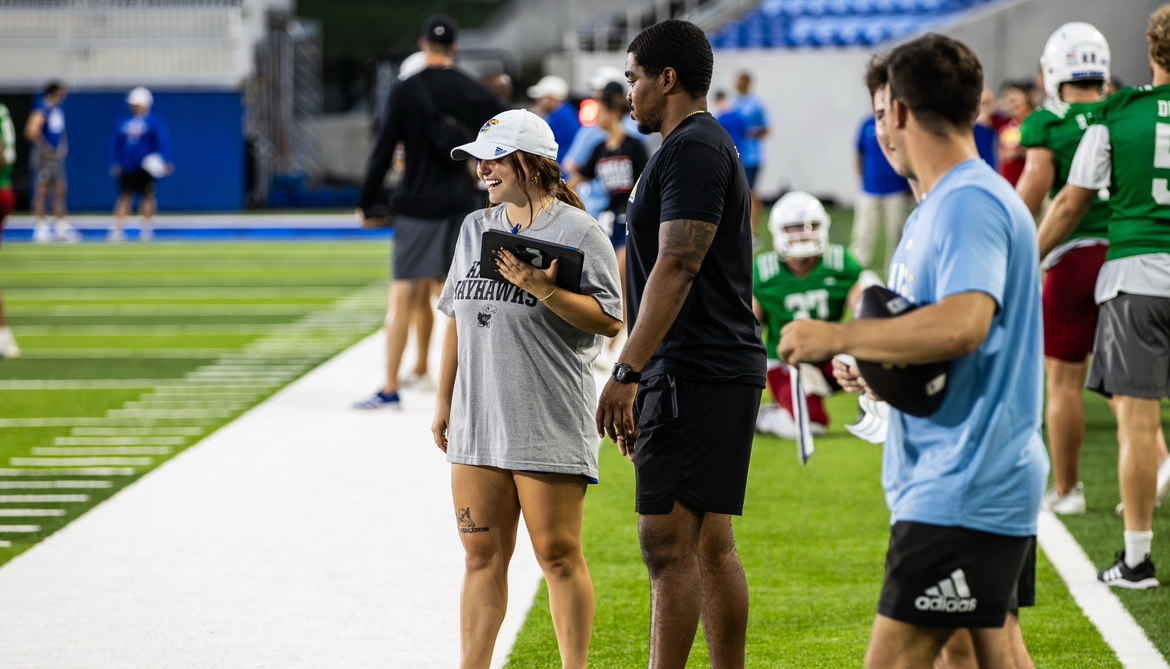
This unique partnership is meant to be long term, integrated and personalized to ensure accuracy in data and convenience for the team. JAPL graduate students are on site every day to collect data and create reports. Rather than taking players out of their training environments to conduct tests in the JAPL lab, technology like heart monitors, GPS trackers and force plates are integrated into the team’s daily operations.
“You can get a lot of good research within the lab and a controlled environment, and that’s great, but how does that translate to what's going on in the field or in the weight room?” said Madi Rink, a sports science doctoral student interning with the KU football team for the Gridiron project. “This collaboration helps us focus on getting valid and reliable real-world data.”
To hone the types of data collected, the project is broken into three components: assessment, development and performance.
Assessment
The assessment component involves the regular assessment of players’ health, fitness, fatigue and neuromuscular performance. This includes things like force plate testing to measure vertical jump height and other movement assessments that then translate into a long-term approach to performance and coaching.
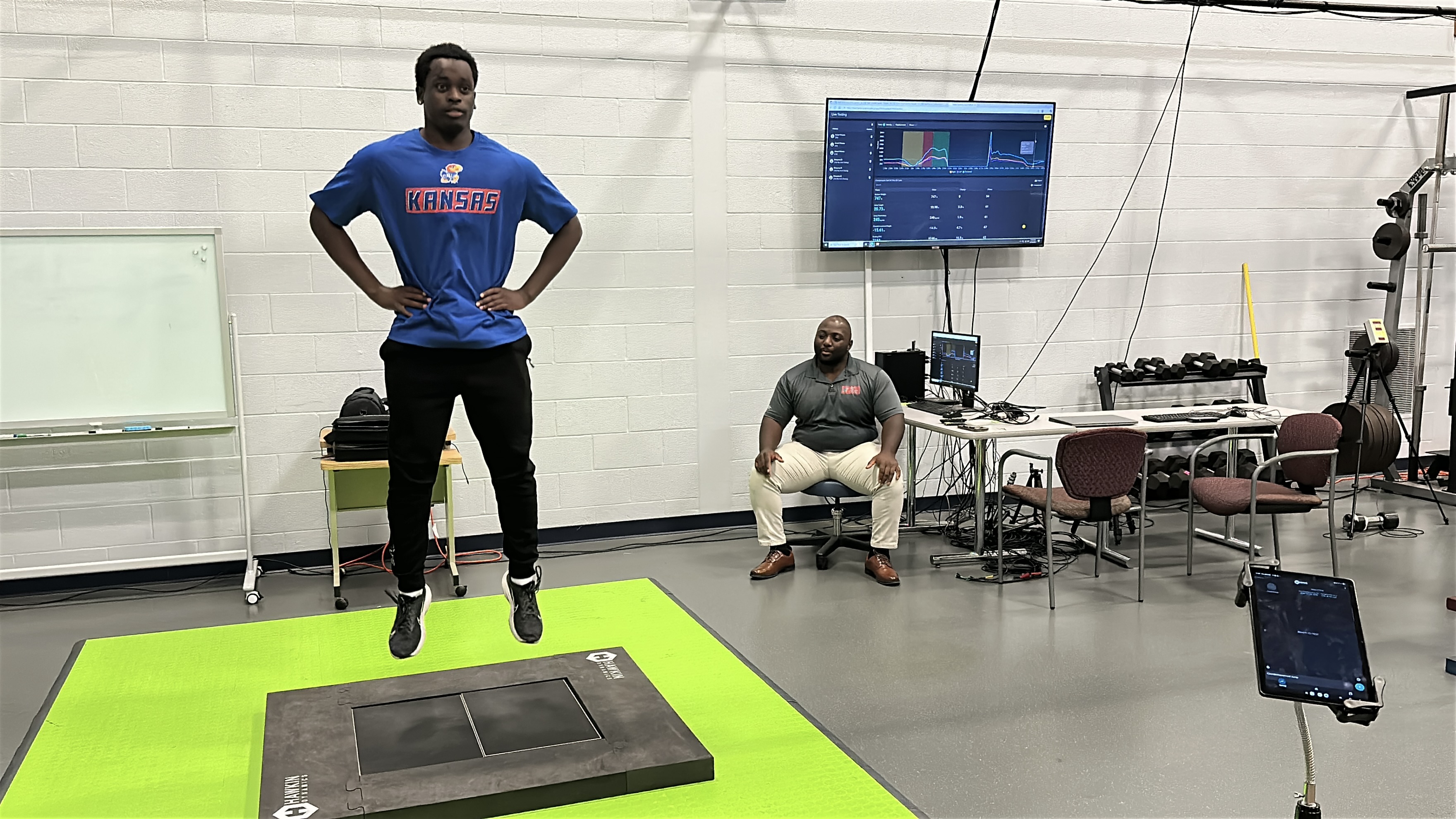
“If we don't understand how athletes function and how they perform, then it makes it more difficult to develop interventions to improve their performance,” Johnson said.
The research conducted in the assessment phase has already led to publications this year on performance indicators for college football, biomechanical characteristics in college football and external training and competition loads in football, a testament to how the Gridiron project contributes to the research field.
Development
Development focuses on training methodology and approaches using a motion capture system in the team’s weight room to track the velocity, loads and intensities of their exercises. Training adaptations can range from muscular endurance and hypertrophy to muscular strength and power.
Researchers work with the KU football sports performance staff to understand how they prefer to train the athletes and what works well for them now so that any changes can be integrated effectively.
“From there, we can understand the exercise choices that contribute to developing American football athletes,” Johnson said.
Performance
Performance covers the team’s practices and games. This involves quantifying the typical demands of practice and different football games such as bowl games and finding ways to reduce risk of injury and improve performance and recovery. This is where GPS technology is used to measure things like sprint distances, acceleration and intensity measurements.
“The GPS samples 10 measurements per second, so it's extremely precise and helps us optimize training approaches, which contributes to better performance outcomes,” Johnson said.
Collegiate-level athletic teams rarely have this kind of knowledge at their disposal, and it has the potential to greatly improve the team’s training and performance.
“We always have to be careful about generalizing research data to another population, so when you can collect data on a given team, at a given place, at a given time, you can be assured that the decisions you make will be much more specific,” Munce said. “This way, you don't have to rely on other research you may come across and wonder if it will also be applicable to your athletes.”
Kevin Kcehowski, the KU football director of sports science and the assistant strength and conditioning coach, said that JAPL has been an extremely useful resource for the team, improving both their performance and their understanding.
“They provide a lot of great resources to us, whether it's actual technology or the huge amount of invaluable knowledge they have to offer,” Kcehowski said. “It’s a very unique partnership that we get to weaponize to make the best version of KU football.”
Many sports teams have traditionally kept their training and performance information guarded in the interest of competitiveness, but Johnson and Munce hope that the Gridiron project can be a blueprint for other athletic teams at KU and beyond.
“We can help individuals do their jobs better and help teams reach levels of success quicker,” Munce said. “All it takes is a conversation to get the ball rolling toward a collaboration and then, the sky is the limit.”